Last week, the Bulgarian parliament decided to give more power to the army. The new amendment in the Armed Forces Act was proposed in the parliament by the conservative party GERB and was later supported by all other parties (the Reformist Bloc, the Patriotic Front, ABC, MRF, BSP, Ataka and BDC). Prior to this decision, the army was only allowed to “assist“ the employees of the Ministry of Interior, for example in logistics. With the new amendment, the military is officially allowed to be involved in border security.
The private television channel bTV reported about two refugee women who have died, in the near of Malko Tarnovo at Strandzha mountain massif on Saturday. Since days the region, where the group was found, saw freezing temperatures. Apparently, the women were part of a bigger group, at least 19 refugees, including 11 children from Iraq and Afghanistan. It was reported, that on Saturday the group was found by the border police. Interior Minister Rumyana Bachvarova told the communication media:
Two women have died — one younger and another middle-aged. Our border guards made every effort to help them, carrying them in their arms to try to warm them up, but it happened because of the cold.
On the 1st of January 2016, new amendments of the Law on the Asylum and Refugees (LAR) came into force. Basically, this change allows the State Agency for Refugees (SAR) “to place asylum seekers in closed centers“, impose curfews for existing open facilities or restrictions on the movement of people that live inside them – this was already published by the State Gazette on October the 16th in 2015. The new regime allows the “detention of unaccompanied minor asylum seekers“, as well. Valeria Ilareva, from the Bulgarian Foundation for Access to Rights (FAR), pointed out that „any detention of asylum seekers exposes them to a high risk of re-traumatisation(…)“.
As many European countries have already considered to build walls at their borders, two politicians of Great Britain and Germany took recently a look at the European border regime, that is partly managed by Europeans pourest country. Lately, the flow of migrants that are entering Bulgaria grew, many of them were arrested and confronted with violence. David Cameron, who visited Bulgaria at the beginning of December, examined different places at the border and the fence. He spoke there with border guards and took a look at the monitors and technical devices at Elhovo police station. The Guardian cited him with the following words:
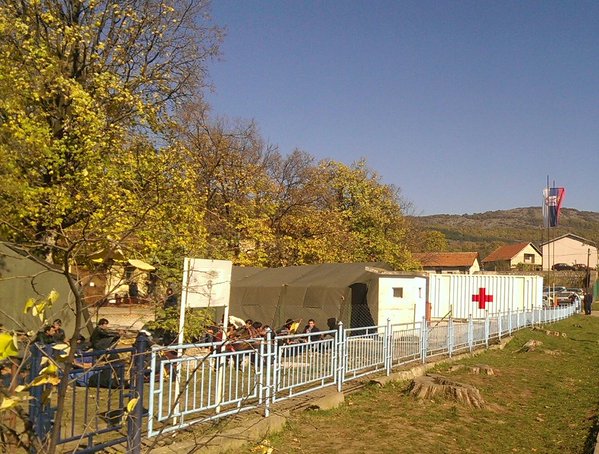
Most of the refugees, crossing via Bulgaria, arrive in Dimitrovgrad, a little town, that is 4 km from the Serbian-Bulgarian Border and 60m away from Sofia, the capital of Bulgaria. They have to register at a camp, that is managed by the Serbian border police. Registered people have to leave the country within three days. Some are walking days before they finally arrive the police station. Taxi Drivers are waiting in front and offer a ride to Belgrade for 200 Euro. Usually they buy a bus ticket to Belgrade for 25 Euro, money that is sometimes provided by volunteers. The volunteers camp is located in the same area as the police station with the tent of the red cross and the presence of the UNHCR. At the end of the working day, the representation of the UNHCR and the Red Cross closed before 4 pm.
Camp in Dimitrovgrad/Serbia
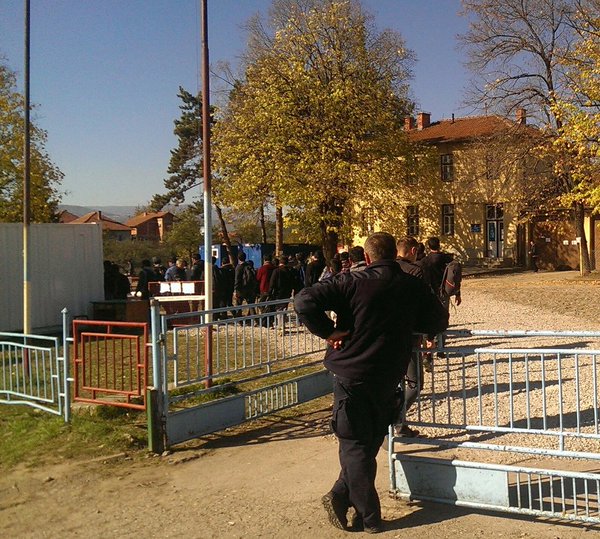
Entrance of the camp
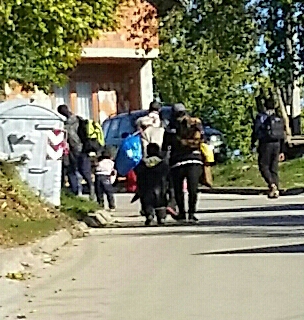
Street in front of the camp
Roughly 300 people, later trying to move on for seeking shelter in other European countries, are arriving in Dimitrovgrad day by day. Most of them are young men, nevertheless, from time to time, there are families that arrive with them. Two unaccompanied minors, Jamal and Sami*, explained what they witnessed in the region at the Turkish-Bulgarian border: “We saw two dead bodies laying on the ground. They did not look well anymore. After the police caught us, they were cutting our backpacks.“
Meanwhile volunteers at the Serbian city of Dimitrovgrad, close to the Serbian-Bulgarian border report about “multiple independent reports of police robbing, beating, and imprisoning refugees“ in Bulgaria. Due to the fence people walk long distances through the mountains and forests to reach Sofia and afterwards the borders of Serbia. At the moment about 200 people cross the Serbian border on a daily basis.
Last night, at around 22h, an Afghani man was shot dead in Bulgaria by border police. The murder has taken place in Sredets in southern Bulgaria, where a group of more than 50 migrants have been stopped by the police. The first information that reached media outlets was that the group resisted arrest which has prompted the border patrol to fire. What actually has happened is that the men were racially profiled as, according to the General Secretary of the Ministry of Interior, Georgi Kostov, “they were obviously not Bulgarian citizens.” Moreover, added Kostov “There is definitely a difference between the profiles of the intruders from the summer months [and those arrested now]…They are most probably economic emigrants (sic!) but this is yet to be determined.”
The immediate reaction of the Ministry of Interior was to distort the event and to build upon a cluster of phantasmagoric stories so as to avoid a scandal. Some of these stories included: two groups of Afghanis invaded the Bulgarian border and opened fire; the two groups were heavily armed; the border police shot in the air as a warning; the bullet ricocheted; the bullet hit a bridge, bounced back and hit the illegal refugee right in the rear. Little did the Ministry of Interior know that a fatal shooting of a guilty border crosser will not result in the stirring of a scandal. In fact, Bulgarian politicians want more blood. This particular spectacle of death was not enough for them. Not surprisingly, Valeri Simeonov, leader of the Patriotic Front, a right-wing nationalist coalition which holds 7% of the seats in the Parliament, immediately requested that Border Police “shoots meat [at the border].” Bozhidar Dimitrov, Head of the National Historical Museum and a former Head of the Agency of the Bulgarians Abroad went as far as to petition for awarding the border policemen who were involved in the incident with the highest order. Tatyana Doncheva, a jurist who has defended companies such as Multigroup, similarly, called for illimitable solidarity with Border Police and suggested that the General Secretary should not feel and show guilt as such events are “normal” for border regions.
After the failure of negations concerning the European quota of refugees, the president of the European Council, Donald Tusk,called Bulgaria and Hungary „exceptional cases“ because of their big „migration pressure“.In addition to the border built between Bulgaria and Turkey, now the Hungarian government decided to build a wall on its border with Serbia. You can read Raia Apostolova’s analysis on the current situation here. The externalization of the European border regime proceeds in full force. Turkey has demanded that Europe needs to manage its migration in a better way, so as to stop the refugees who enter the continent and better secure its gates. Already in May 2015, Bulgaria, Turkey and Greece signed for a common contact centerand agreed upon the establishment of joint border patrols. The circumstances for refugees in Turkey are not improving. You can read Mathias Fiedler’s article on the situation here.
Just until recently, asylum-seekers in Bulgaria received 65 BGN (33EUR) a month as part of the state’s social welfare designated to people in need. We are worried to learn however, that even this moderate social provision will be taken away from those seeking protection as of April 1st. This is part of the government’s efforts to both make Bulgaria unattractive destination but also because of the severe socio-economic situation in the country, which deepens exclusion by the day.